
Margins
On secondhand books.

In early March 2026, I picked a book from a shelf in my office.
It was the 1970 Chekhov Publishing House edition of Nadezhda Mandelshtam’s memoirs, and I’d gotten it from David Bethea, one of my teachers at Wisconsin. By the time I started working at UW-Madison in 2017, he had already retired, and I briefly occupied his old office. One day he came to clean out his library and told me to take whatever books I needed. I took this one without looking closely.
There was a signature on the half-title: N. Berberova. What had been sitting unrecognized on my shelf for almost nine years turned out to be Nina Berberova’s own copy. That it would end up in Bethea’s office was conceivable: he had known Berberova personally. In the book, Berberova left notes throughout, almost always very short: underlined dates, names, question marks in the margins. In a couple of places, next to the names of people Mandelshtam mentions, she wrote one word: “killed” (“убит”). On one page there were two such markings, next to the names of Nikolai Bukharin and Mikhail Vinaver. It was as if she was rewriting the memoir in her own macabre way.1
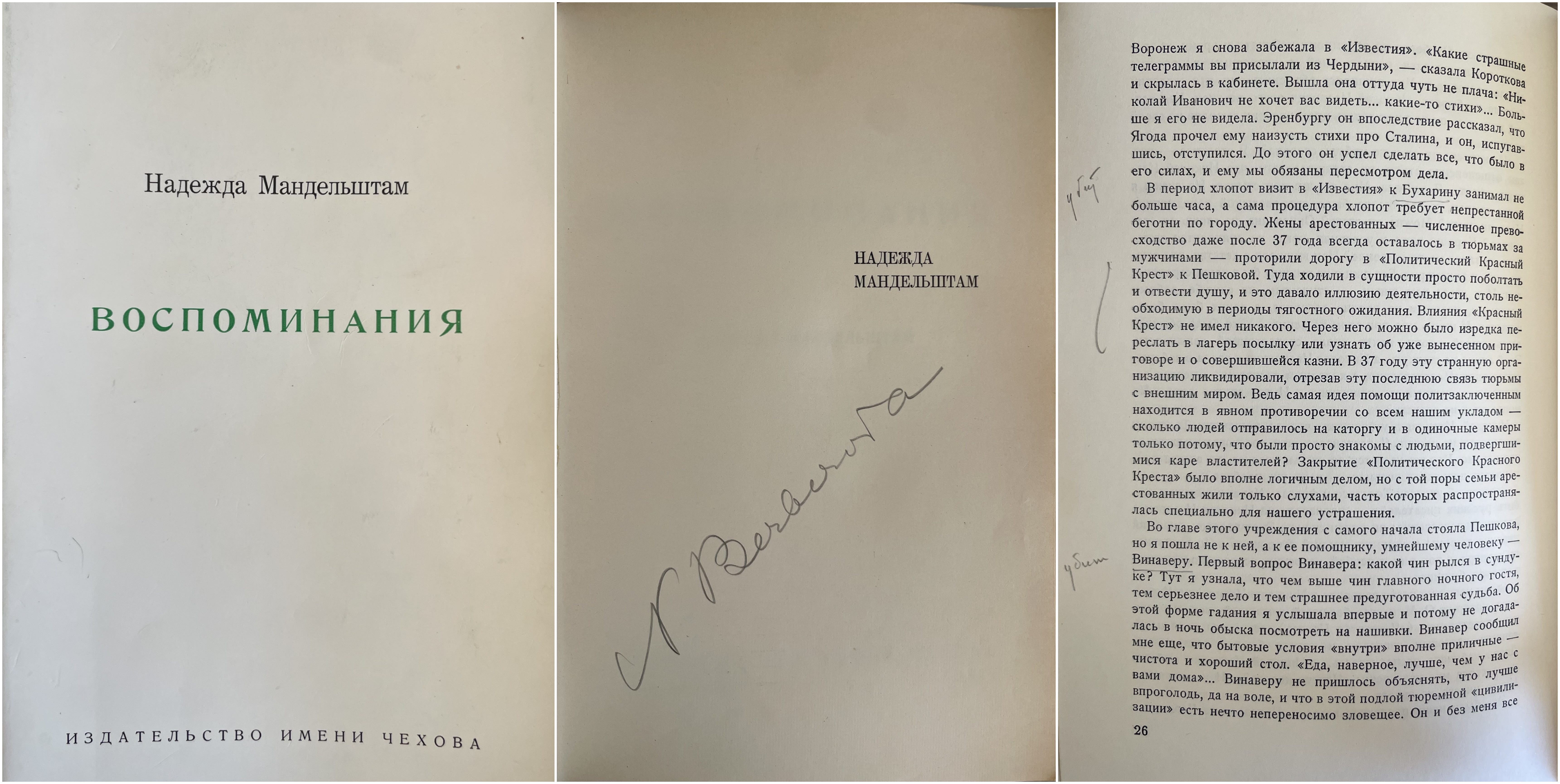
The marginal notes in cursive were like a famous voice in duet with the original print matter. These two women, scarred by the twentieth century in very different ways and, as far as we know, having never met in person, seemed to have a conversation through the object in my hands.
I don’t know if Berberova had ever imagined that her short marginal notes would be studied and published. Coleridge, on the other hand, helped popularize the genre in English literary culture when he published his Marginalia on Sir Thomas Browne in Blackwood’s Magazine in 1819. After Coleridge’s death, his nephew collected his book annotations and published them as part of the morbidly entitled Literary Remains of Samuel Taylor Coleridge (1836-1839).2
Most marginalia never get published. They survive, if at all, by accident, detached, scattered, and rediscovered in old books which outlive their owners.
Unstolen Euripides
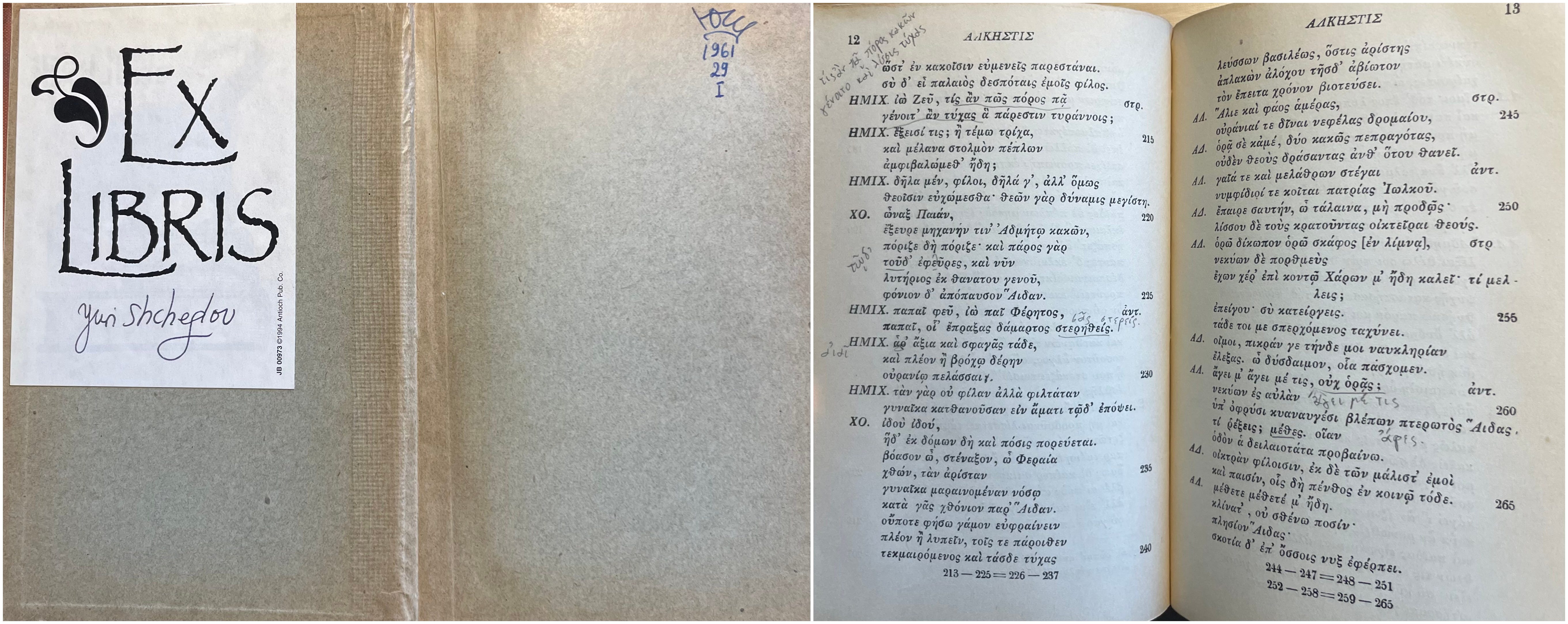
I first arrived in Madison from the University of Virginia, where I had done my M.A., in 2007. I was going to study Latin and ancient Greek at the University of Wisconsin — a five-year detour — while still working on my doctorate in Russian studies. Towards the end of my first year, I went to the most famous secondhand bookstore on campus, Paul’s Books, on the 600 block of State Street. There, among thousands of irrelevant things, I found a three-volume Euripides (Leipzig, 1909), a reprint of Nauck’s Teubner edition — with the ex libris of one of my professors in the Russian program, Yuri Shcheglov. The connection was unexpected, even worrisome. I bought the set, came home, and emailed Shcheglov immediately to ask, in all seriousness, whether he had been robbed. If so, I would be happy to return at least three volumes from his library at his earliest convenience. He replied, as seriously, that his library was intact, but he had recently given up his old Euripides after acquiring a new Loeb edition with a parallel English text.
Shcheglov was a celebrity among the celebrities in my department. I had only had one semester with him before he retired from teaching, and the Greek connection was my way of claiming a place, however tenuous, in the vicinity of the long tradition of literary scholarship.
When Shcheglov acquired this edition in Moscow in 1961, he was twenty-four years old and the books were fifty-two. When I got these books, I was twenty-five and they were ninety-nine. That year, I read the Medea with a former girlfriend, who happened to be classically trained, in Denys Page’s annotated edition and translated it into boring English prose. The following year, I reread the play in Donald Mastronarde’s modern edition and wrote a paper on the concept of θυμός for a graduate seminar with Silvia Montiglio. Another year later, I finally had enough Greek to return to Shcheglov’s Teubner and read two plays, Alcestis and Ion, in it — correcting Nauck’s old readings against later editions such as the Loeb. Yuri Shcheglov died in 2009, and his was the first funeral I attended in America. Suffering from social anxiety, I didn’t approach the casket.
Attic Nights
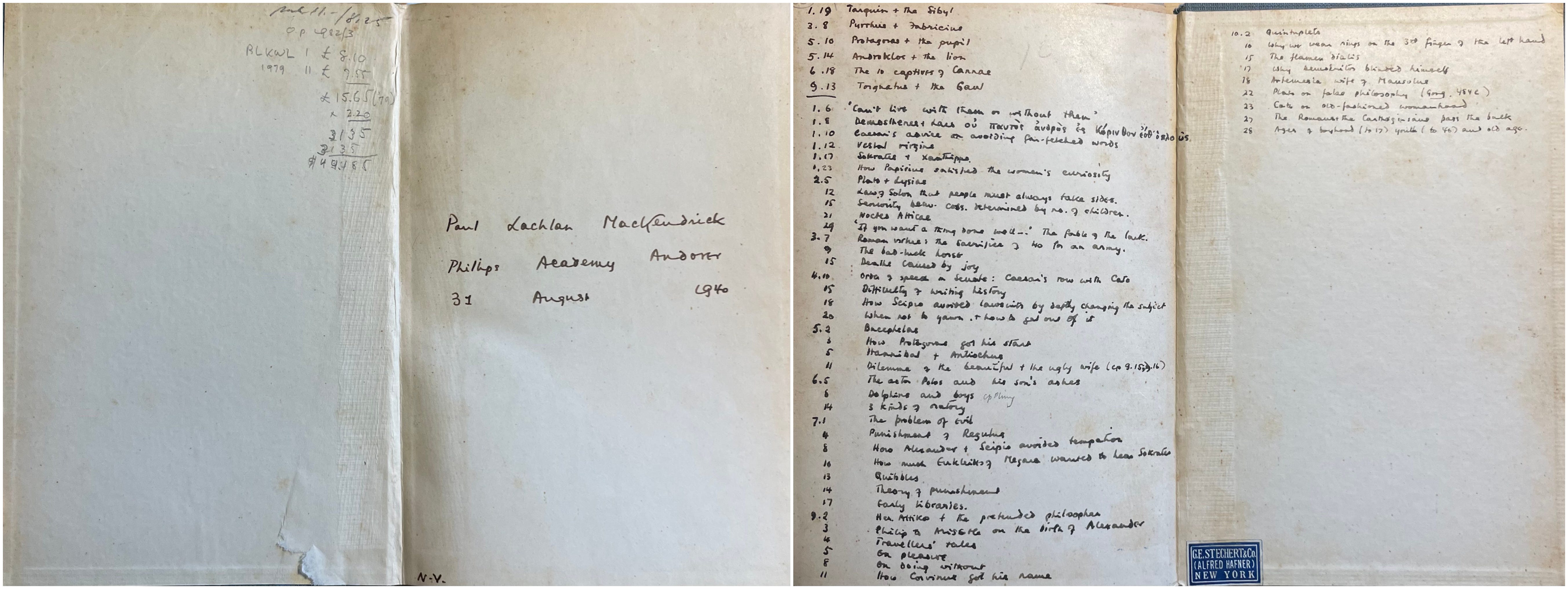
On the cover of the Teubner edition of Aulus Gellius’s Noctes Atticae, vol. 1 (Leipzig, 1937; reprint of the Hosius edition), next to some arithmetic in pounds sterling and dollars, there was a name, a place, and a date: “Paul Lachlan MacKendrick, Phillips Academy Andover, 31 August 1940.” On the endpaper was a long handwritten index to the volume’s contents in the owner’s minuscule hand: “Tarquin & the Sibyl,” “Androkles & the Lion,” “Deaths Caused by Joy,” “How Scipio avoided lawsuits by deftly changing the subject.” In the lower right near the spine crease, a stamp identified the bookseller: G. E. Stechert & Co. (Alfred Hafner), New York.
Educated at Harvard and Oxford, Paul MacKendrick (1914-1998) was a classics professor at UW-Madison. Before joining the U.S. Naval Reserve and serving from 1941 to 1945, while still in his twenties, he had briefly taught at Phillips Academy in Andover, Massachusetts, where he had among his pupils the future President of the United States George H. W. Bush — his Wikipedia page drily says that “Professor MacKendrick recounted this to a Latin course at the University of Wisconsin attended by the author of this note.” Among MacKendrick’s own works was The Mute Stones Speak (1960). The Aulus Gellius probably traveled with the owner abroad during the war, and I purchased it at Paul’s Books on the same day as the Euripides.
Aulus Gellius compiled the Noctes Atticae in the second century out of his annotationes — notes on things read or heard, made to help memorization (ad subsidium memoriae) — and he left them much as he first gathered them: “briefly, indigestedly, and haphazardly” (breuiter et indigeste et incondite; Praefatio 1.2-3).
With the Renaissance came not simply printing but a large-scale accumulation of both manuscript notes and printed miscellanies and marginalia. In Ann Blair’s memorable phrase, it was the result of “a newly invigorated info-lust that sought to gather and manage as much information as possible” (Ann M. Blair, Too Much to Know: Managing Scholarly Information before the Modern Age. Yale University Press, 2010, p. 6).
In the sixteenth and seventeenth centuries, as these unstable genres were being reshaped within new practices of reading, excerpting, and compilation across Europe, they made personal essayistic prose imaginable. When Michel de Montaigne (1580) called his citation-heavy writings essais — trials, attempts — he was, at least in part, naming the risk of uniting disparate material by a distinct personal voice. Robert Burton’s Anatomy of Melancholy (1621) didn’t know itself whether it was a medical treatise on what we would today probably call depression or an etceterative essay. And Sir Thomas Browne brought his curiosity into a digressive meditative miscellany that became a genre of its own.
In 2001, in one of the first book-length modern studies of marginalia, H. J. Jackson noted that “once a reader’s notes are published on their own account, as Coleridge’s were, it becomes possible that any of them might be publishable, and all annotators become more self-conscious in their work” (H. J. Jackson, Marginalia: Readers Writing in Books, Yale University Press, 2001, p. 7). After Coleridge, Edgar Allan Poe took this further in his Marginalia, treating the annotating voice as a personal prose form:
In the marginalia, too, we talk only to ourselves; we therefore talk freshly — boldly — originally — with abandonnement — without conceit — much after the fashion of Jeremy Taylor, and Sir Thomas Browne, and Sir William Temple, and the anatomical Burton, and that most logical analogist, Butler, and some other people of the old day, who were too full of their matter to have any room for their manner, which, being thus left out of question, was a capital manner, indeed, — a model of manners, with a richly marginalic air. (Edgar Allan Poe, “Marginalia [part I],” United States Magazine and Democratic Review 15 (November 1844), p. 484.)
By the twentieth century, Virginia Woolf, who kept reading-notebooks rather than marking books, pointed out that Sir Thomas Browne’s “immense egotism has paved the way for all psychological novelists, autobiographers, confession-mongers, and dealers in the curious shades of our private life. He it was who first turned from the contacts of men with men to their lonely life within” (Virginia Woolf, “The Elizabethan Lumber Room” in The Common Reader. London, Hogarth Press, 1925, pp. 69-70). Yet Woolf found the exuberant autonomy of personal marginalia threatening, and the presence of another mind in the act of reading intolerable.3 Vladimir Nabokov, who learned from Woolf while publicly denigrating her, created a whole novel around an annotator imposing on the private and intimate scene of reading.
Eighteen centuries earlier, Aulus Gellius was already navigating the tension between memory-straining overabundance and personal voiced selection. Writing at a time when Greek and Latin literatures had swollen beyond anyone’s capacity to read, let alone remember, he offered brevity and variety, a veneer of culture, as compensation — and in doing so provided an early model for the essayists’ loose, meandering, free-ranging form.
A foremost authority on Aulus Gellius, the Oxford polymath Leofranc Holford-Strevens edited the English translation of Mikhail Gasparov’s History of European Versification (1996). Gasparov then modeled his own miscellany Notes and Excerpts (2000) on Aelian, Plutarch, and Aulus Gellius. It was that book that reconciled my creative ambition to my philological studies at seventeen in the first place — and I’ve kept it, with the dated purchase receipt pasted in, for years.
What drew me to marginalia, miscellany, and essay was that they made room for minds that arrived sideways. Gasparov’s seemingly disorganized textual omnivory let him escape formal hierarchies and conventions of genre. He was a middle-aged classics scholar, an expert in versification, and a translator — writing a personal book. He found a form where his literary ambition was de-centered enough not to be held against him. The muted indirectness with which he seemed to handle his own literary marginality was clever and exhilarating.
From Gasparov I learned that creative ambition could hide inside scholarship, live in the commentary on the margins of the main text. The compromise once served me as a survival strategy but then became a marginality of its own. Antiquity and the old books I kept acquiring were in large part how I started reading and writing my way past it — in pursuit not so much of fullness of knowledge, as of private surprise.
Frogs and Two English Teachers
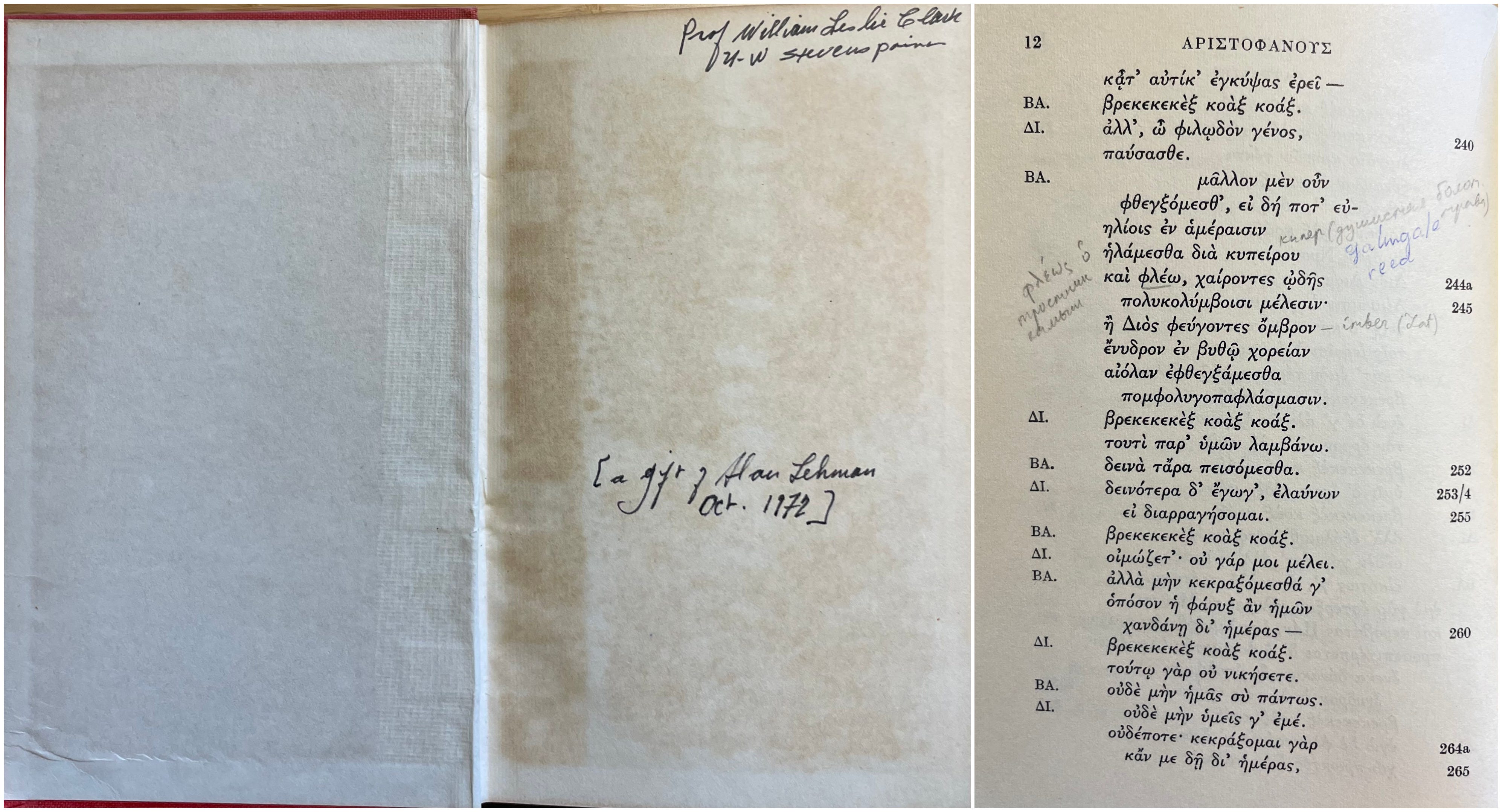
Around 2015, at Paul’s Books, I bought W. B. Stanford’s 1958 annotated edition of Aristophanes’s Frogs with the following inscription: “Prof. William Leslie Clark, UW–Stevens Point. A gift of Alan Lehman, Oct. 1972.” It took me over a decade to find out that Lehman belonged to MacKendrick’s war-marked generation, studied English and classics, and taught Chaucer and New Testament Greek at Stevens Point, while Clark, almost twenty years his junior, taught English literature there.
Inside the book, I exchanged notes with one of these two men — whichever of them read that far — translating both the obscure original κύπειρον and the equally obscure “galingale” into passable but botanically questionable Russian. This is the place in the play where the chorus of frogs breaks into its famous croaking.
Was the notation identifying the giver a concession to professional etiquette, a token of admiration and respect, a sign of personal warmth? All I have is a trace of a relationship.
When Walter Benjamin unpacked his library in an essay in 1931, a few years before displacement scattered it forever, he gave later generations a language for tying scholarly identity to the materiality of personal book collections. In that language, the partial trace of a relationship preserved in a book inscription is not incidental to scholarship. It’s one of the forms scholarship takes in life.
Both my almae matres produced scholars sensitive to that. In 2012, William Cronon, a historian at UW-Madison (and president of the American Historical Association at the time), drew on Benjamin to describe how the scholarly self built through passionately remembered texts — “many of them so dear that we keep them close to us for our entire lives” — was being dissolved in what he called “the fragmented world of search and scroll.” He saw no way to reverse the trend. Two years later, Andrew M. Stauffer, an English professor at UVa where I’d started graduate school in 2005, launched a project preserving the marginal notes in print books that libraries were discarding as they digitized. Among his finds was a copy of Longfellow annotated by two lovers who were then parted, one of them returning years later to write her grief in the margins beside the old notes.4
The Aristophanes appears to link me to the Greek text, to a twentieth-century annotator of Greek texts, and to two English teachers in Wisconsin, one of them quietly marking his relationship to the other. But all that really survives here is a residue of human exchange, inseparable from the object.
Catullus in the Midwest
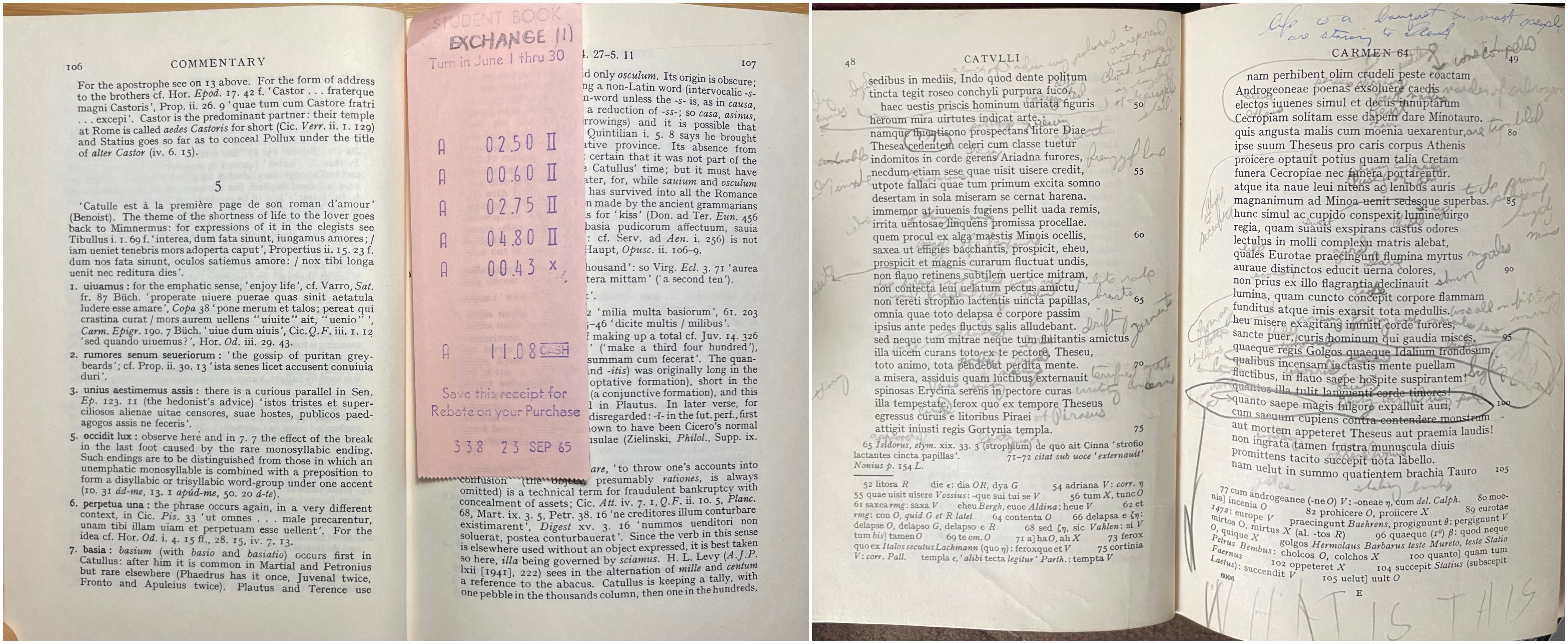
Around 2009, from Paul’s Books came a 1965 Oxford edition of Catullus by C.J. Fordyce. A pleasure to read, the book never apologized for giving ancient Greek without translating it and for casually drifting into French, also sans translation. At the time, Fordyce was still famous for being the “best” student edition of Catullus — and for sanitizing all of his erotica. That was why we never used it in class, relying instead on Daniel H. Garrison’s The Student’s Catullus, which gladly printed and explained the obscene poems.
In the copy I got, a previous reader left visible traces of textual suffering — penciled in all caps: WHAT IS THIS. Without the question mark, the outcry was haunting. It pointed to the corrupt but still readable line 100 of Catullus 64: quanto saepe magis fulgore expalluit auri, “how much paler did she [Ariadne] often grow than a gleam of gold” (taking quanto as ablative of comparison with magis, per Fordyce). When I bought the book, I wanted to clean it up. But then I decided to keep the mess — because of the suffering and the bafflement. In my time, graduate students in classics put “WTF?” next to a difficult word — which, as they politely explained to anyone who asked, stood for “Why this form?”
On the cover was a semi-legible price tag, $4.80, and inside the book a receipt dated September 23, 1965. It had remained there since the book was new.
Nina Berberova’s signed books are for sale on eBay for $200 apiece. But the traces I’m inventorying here are too random to serve a Jamesian collector of bibelots or generally to have much monetary value.
Nor is their value sentimental, really. They are embodied traces in physical objects that resist the logic of mechanical reproducibility. They can be copied as information, but never fully as situation. They’re fragile, accidental, and destined to disperse, which makes them irreplaceable.
They are also absurd — like the discarded papyrus fragments used to wrap and stuff crocodile mummies in the crocodile cemetery in Tebtunis, Egypt, in the second and first centuries BC, and discovered by accident by the Oxford archaeologists Bernard Grenfell and Arthur Hunt excavating there in 1900, with funds generously provided by the mother of William Hearst (of Citizen Kane fame). The line ἐρῶ μαίνομαι κατ<έ>αγμαι ἐμ[ (P.Tebt. 2d. v, 14), “I’m in love, I’m going mad, I’m in pieces,” in a female voice, had spent two thousand years inside Crocodile 23 before it was read again.
Drawing Outside the Lines
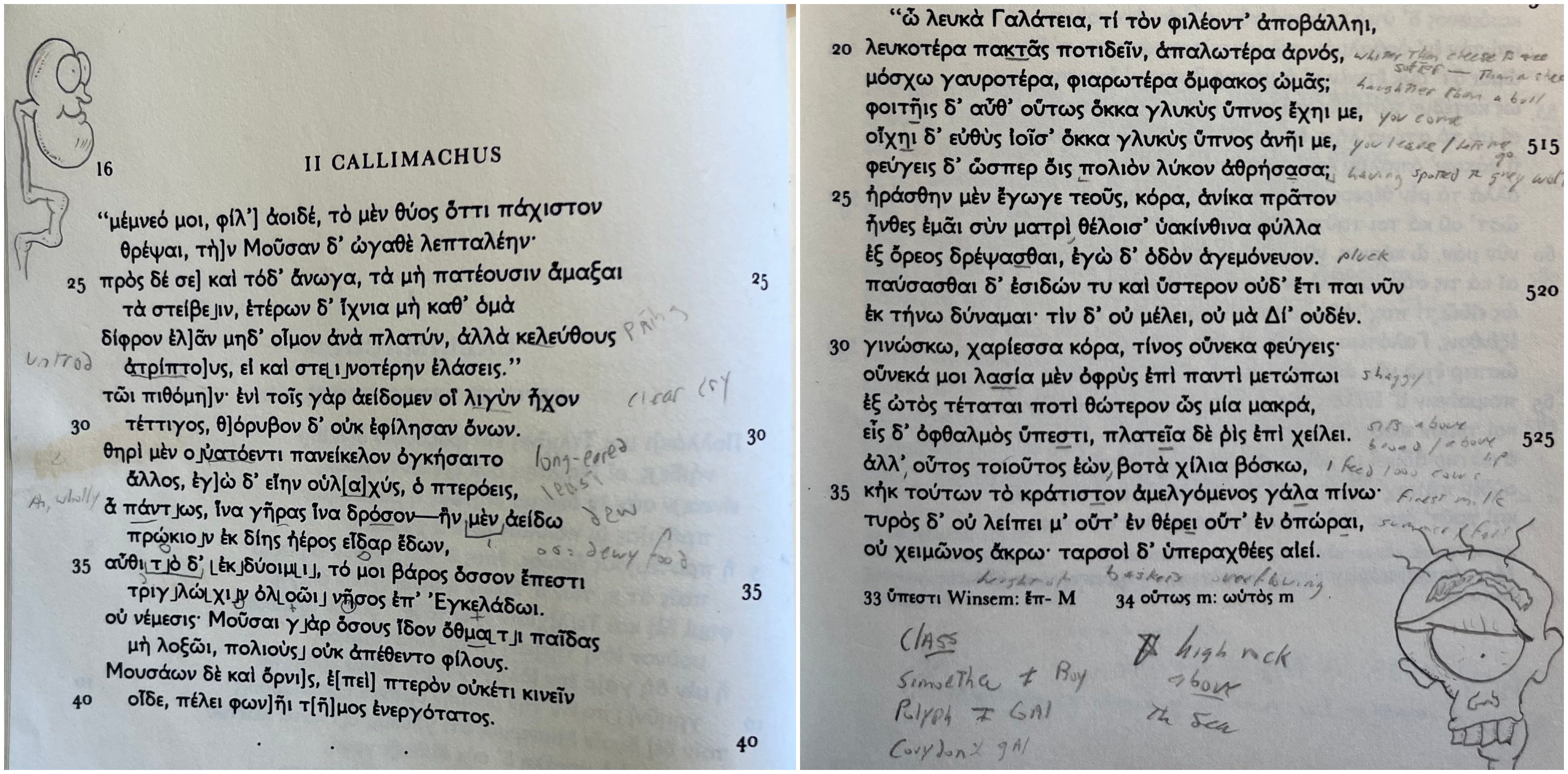
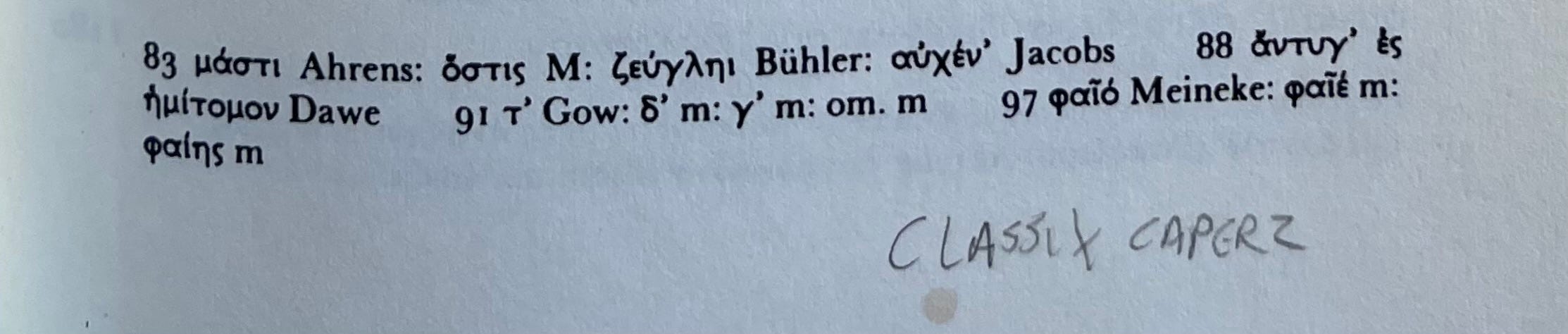
The 1999 Cambridge Greek and Latin Classics edition of A Hellenistic Anthology came with some drawings, and the one-eyed face appeared, appropriately enough, in the corner of Theocritus’s idyll 11, “The Cyclops.” At the bottom of one of the pages was a phrase: CLASSIX CAPERZ, somehow a perfect description for the entire thing: erudite Hellenistic bagatelles, their modern-day edition, and a grad student (I presume) having fun with their Greek. The book came, around 2011, from Paul’s Books, where there were customers’ drawings on the walls and the section signs were all hand-lettered.
In February 2025, Paul’s Books closed after seventy years as a campus landmark. Paul and Caryl Askins had opened the store in 1954. After Paul’s death in 1975, it was Caryl’s baby, according to their daughter Martha. When I brought my own books to sell there, I would talk to Caryl. She never offered me more than $20, no matter how many bibliophilic rarities I left with her. The classics section enjoyed pride of place in her store, behind the counter, where few people dared browse freely. Classical knowledge was an exclusive thing, and I liked the store for acknowledging it.
Family-owned bookstores are another kind of loss on the list. But the usual explanation — the market — doesn’t apply here. “Business is thriving,” Martha Askins said in the interview about the store’s closing. The current customer base alone, she suggested, could have carried it for another seventy years. The simple truth was that there was no one left to care about the store after Caryl’s retirement at ninety-four. I’m glad to have shared in a slice of this history, sustained as it was by an aging woman’s love of books and by the memory of her long-gone husband, in a college town where readers never age.
Fata Libellorum
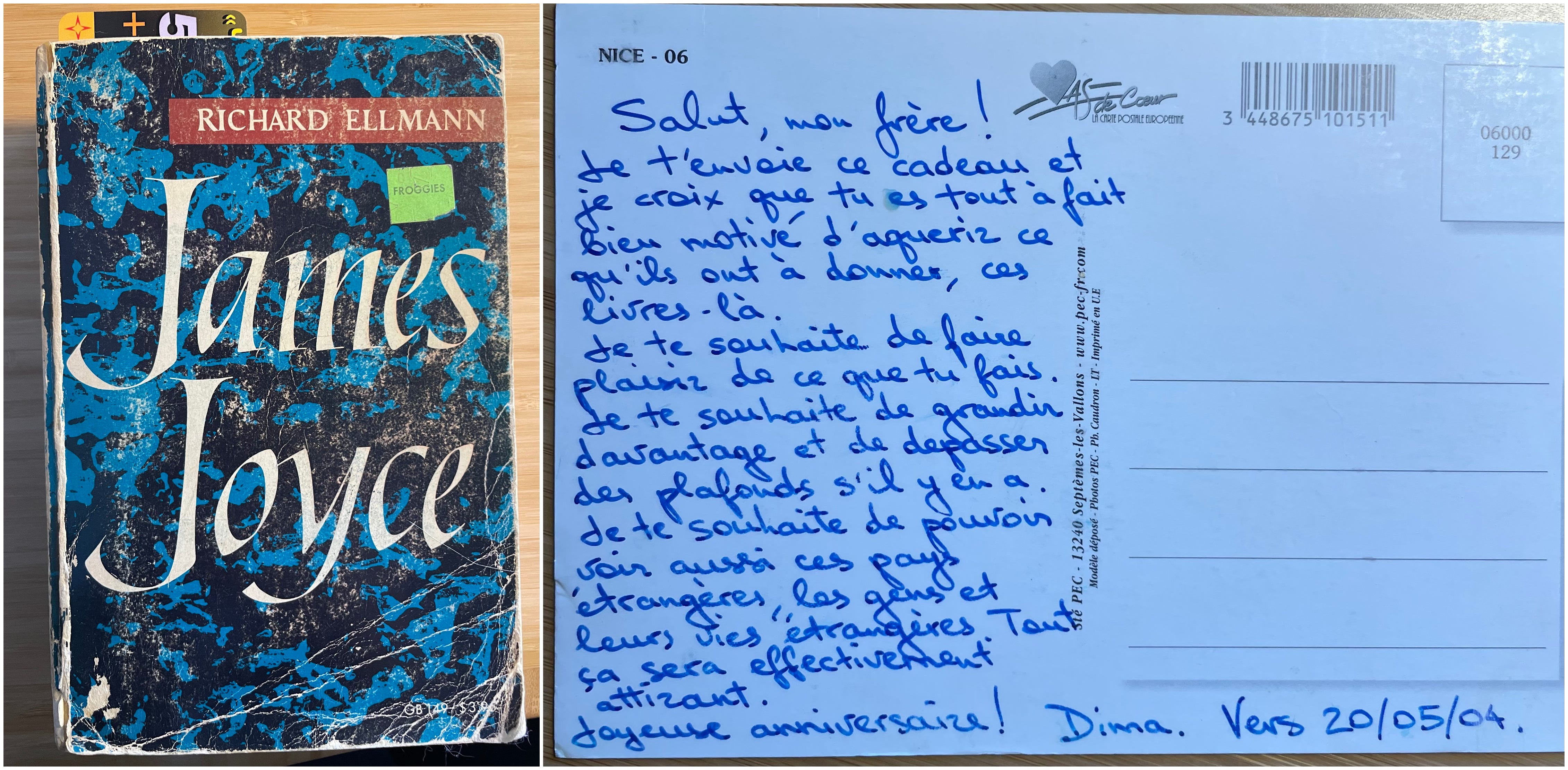
This battered copy of the first edition of Richard Ellmann’s James Joyce came from Nice, France, to my family’s apartment in Irkutsk just in time for my twenty-second birthday in 2004, along with Henri Bergson’s L’Évolution créatrice and a postcard from my brother. The paperback did what few paperbacks ever do. It traveled from America to France, from France to Siberia, from Siberia to St. Petersburg, and eventually back to America. My brother’s birthday wishes, complete with some forgivable errors in grammatical gender, remind me that we both studied French in our late teens at the local office of L’Alliance Française in Irkutsk; that we both first traveled abroad in our early twenties; and that at the time we still shared how much the experience changed us. Depuis lors, comme prévu, j’ai bel et bien dépassé plus d’un plafond.
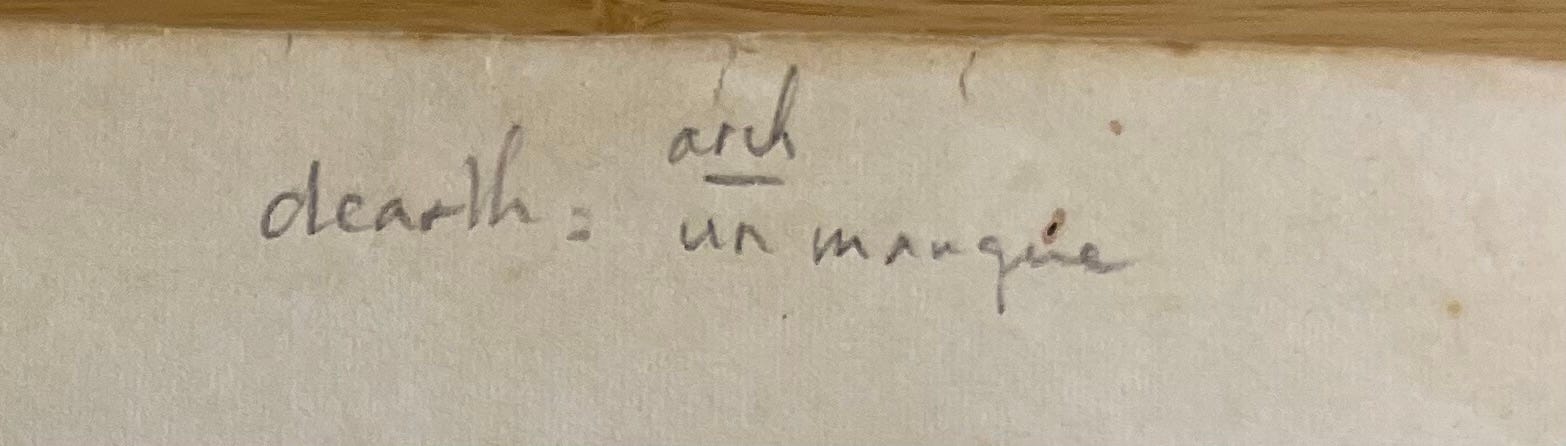
Inside the book, there’s only one penciled marking on the endpaper: “dearth: un manque” (“arch” is presumably for “archaïque”), an ideal illustration of its meaning.
Commonplacing
Twenty years ago, the Joyce biography fed into a collection of chaotic notes I called Sottisier, or The Commonplace Book. I eventually sent it to Russia, where it was long-listed for the Debut Prize in 2006. It didn’t make the shortlist. The words “sottisier,” from a biography of Samuel Beckett, and “commonplace book,” from a biography of Shakespeare, were meant as a kind of pre-emptive defense for that eventuality, and it did earn me my first major publication, a short story about the emotional sink-or-swimming of an English exchange student in a Siberian town.
Today, a text that looks like an annotated miscellany can be produced without the reading behind it. The contents of Sottisier matter less in this context than the remembered aura of its conception. This is what the classical books, including Berberova, preserve: adjacency. The physical object insists that a remainder is more than a record.
During my years of literary apprenticeship, I was less concerned with “greatness” or even “respectability” than with finding a way out of invisibility. But visibility is not always about accumulation. There’s a side to accumulation that has to do with spending. Subtraction after addition.5 The art of loosing that isn’t hard to master.6
Reading marginalia in print books may feel like reading obituaries, and personal books dispersing in life may look like a rehearsal of personal dispersal. But digitization, shedding everything that doesn’t fit onto the screen and fleeing the more loss-prone aspects of material life, is not the horizon. Loss is. And private surprise works better against loss, I find, than digitally secure, endless knowledge.
In my twenties, I learned ancient Greek with an Italian accent, and Latin with an Irish one. My teachers, in their turn, had learned ancient languages from people with other accents in Paris and Oxford. I hold on to those accents no less than to my teachers’ books. But the books, which I bought at brick-and-mortar stores and which shape my thinking about wandering and cabinets of curiosities, are inspirations for writing in my own genres. The home will one day stand empty, and the remainders may end up in a jumble of secondhand volumes and digital scrap — but there will be other curious hands and minds looking for private surprise, and for now the home stands full of sound, alive.
Berberova wrote “killed,” but Mikhail Vinaver’s fate was murkier. According to a 2009 edition of letters of Vinaver and Peshkova to Kuskova, he was arrested in 1937, amnestied in 1942 as a Polish subject, and then died of unspecified causes that same year — or reportedly sent to Anders’ Polish army at his own request in 1943, fell ill and died en route (Винавер М. Л., Пешкова Е. П. «Наш спор с Вами решит жизнь»: письма М. Л. Винавера и Е. П. Пешковой к Е. Д. Кусковой, 1923-1936. Составитель, предисл., коммент.: Л. А. Должанская. М.: АСТ: Восток-Запад, 2009, с. 143). Whether this counts as “killed” is its own question.
Sir Thomas Browne’s baroque compendium of common errors Pseudodoxia Epidemica (first ed. 1646) was a space where unexpected things surfaced — including early thinking about gender. His is the first recorded use of the terms “transfeminated persons” and “transexion” in the English language, albeit in a chapter on hares and in a sense opposite to today’s usage: women turning into men. The subsequent inversion of the definition in late-nineteenth-century dictionaries was “symptomatic of an epistemological shift in the sex/gender system… one that rendered the notion of trans-femininity possible” (Joseph Gamble, “Toward a Trans Philology,” Journal for Early Modern Cultural Studies 19.4 (2019), p. 26). Coleridge described Browne as being the first to have injured the literary taste of the nation by introducing learned words merely because they were learned — and then proceeded to paint him with contrastive colors: “exuberant in conception and conceit, dignified, hyperlatinistic, a quiet and sublime enthusiast; yet a fantast, a humourist, a brain with a twist; egotistic like Montaigne, yet with a feeling heart and an active curiosity, which, however, too often degenerates into a hunting after oddities” (The Literary Remains of Samuel Taylor Coleridge, vol. 1. London: William Pickering, 1836, pp. 235-236). Coleridge went so far as to recognize a mind similar to his own in Browne, “an affectionate visionary” (Literary Remains, p. 242). Browne’s mystical attitude to knowledge was noticed by readers across centuries, from the contemporary Parisian doctor Guy Patin whose letter described Religio Medici as “tout gentil & curieux ; mais fort délicat & tout mystique” (Nouvelles lettres de feu Mr. Gui Patin, t. 1. Amsterdam: chez Steenhouwer et Uytwerf, 1718, p. 88) to William P. Dunn’s modern reproach to Pseudodoxia Epidemica, where Browne “wrote science like a rhapsodic monk… he sees everything through a cloud of mystical emotion… His enthusiasm for truth is not steady and cool, but always lyrical” (William P. Dunn, Sir Thomas Browne: A Study in Religious Philosophy. University of Minnesota Press, 1950, p. 126). Apart from having an endearing habit of “floating and inventive curiosity,” Browne was a stylist with an unforgettable cadence: “Knowledge is made by oblivion, and to purchase a clear and warrantable body of Truth, we must forget and part with much we know” (Pseudodoxia Epidemica: or, Enquiries into Very Many Received Tenents and Commonly Presumed Truths. London: Thomas Harper for Edward Dod, 1646, p. a 3).
Virginia Woolf herself was one of the great heirs of that inward, essayistic tradition. Her judgment on Browne is all the more striking for it. If she is partly echoing Coleridge’s description of Browne as “egotistic like Montaigne,” she also leans more heavily into the charge. But then she called Joyce’s manner in Ulysses “egotistic,” too. Maybe what matters here is less inconsistency than a tension. A writer may claim the freedom of private voice and still resist another consciousness intruding on, and even, in her words, violating, the intimate act of reading (“How Should One Read a Book?” in The Common Reader, 2nd series. London: Hogarth Press, 1932, p. 268; Hermione Lee, Virginia Woolf. London: Vintage, 1997, p. 412; and especially Jackson, Marginalia, pp. 239-242).
“I realized that Joyce had gone as far as one could in the direction of knowing more, in control of one’s material. He was always adding to it; you only have to look at his proofs to see that. I realized that my own way was impoverishment, in lack of knowledge and in taking away, subtracting rather than adding” (Samuel Beckett in an interview with James Knowlson, October 27, 1989). Beckett connected this realization with a pivotal moment in his mother’s room in Foxrock, Dublin, in early 1946: “the day I became aware of my own folly. Only then did I begin to write the things I feel” (James Knowlson, Damned to Fame: The Life of Samuel Beckett. New York: Simon & Schuster, 1996, p. 319). Decades earlier, he had articulated another version of this contrast with Joyce: “The more Joyce knew the more he could. He’s tending towards omniscience and omnipotence as an artist. I’m working with impotence, ignorance. There seems to be a kind of esthetic axiom that expression is achievement — must be an achievement. My little exploration is that whole zone of being that has always been set aside by artists as something unusable — as something by definition incompatible with art” (Israel Shenker, “Moody Man of Letters…” The New York Times, May 6, 1956, quoted in Knowlson, Damned to Fame, p. 686).
“In her celebrated poem ‘One Art,’ Elizabeth Bishop’s repeated refrain is ‘The art of losing isn’t hard to master.’ In its insistence on a purgative aesthetic, it’s the one poem of hers I’ve never liked; I picture it on a refrigerator magnet, say, urging dieters not to open the door. A more congenial version to me would invoke the art of loosing: and not as one art but a cluster of related ones. Ideally life, loves, and ideas might then sit freely, for a while, on the palm of the open hand.” (Eve Kosofsky Sedgwick, “Introduction” in Touching Feeling: Affect, Pedagogy, Performativity. Durham, NC: Duke University Press, 2003, p. 3.)